
What Is Gearbox Service Factor?
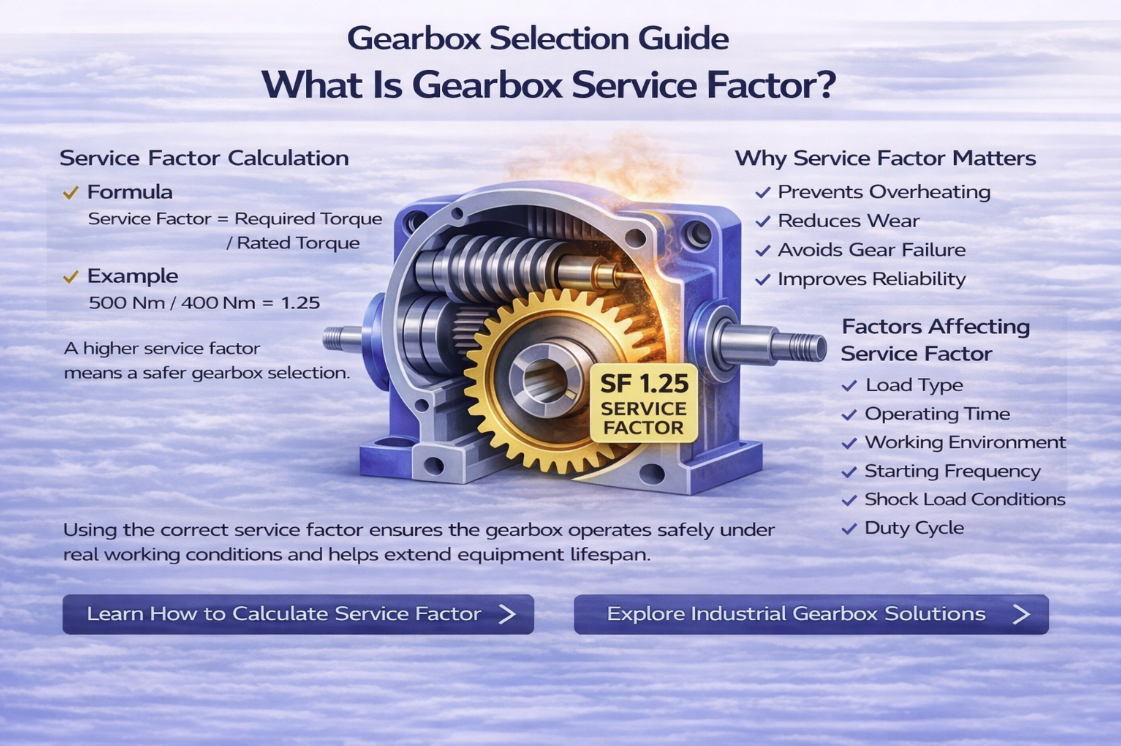
The gearbox service factor is a safety coefficient used in gearbox selection to account for operating conditions such as load variations, shock loads, and working hours.
It ensures that the selected gearbox can handle real-world conditions beyond theoretical calculations.
In industrial applications, the gearbox service factor helps prevent premature failure and improves system reliability.
Gearbox selection requires careful consideration of operating conditions and load requirements.
Why Gearbox Service Factor Is Important
Ignoring the gearbox service factor can lead to:
Gearbox overheating
Premature wear
Unexpected failure
Increased maintenance costs
By applying the correct service factor, engineers can ensure that the gearbox operates safely under varying conditions.
How to Calculate Gearbox Service Factor
The simplified formula is:
Service Factor = Required Load Torque / Rated Gearbox Torque
Example:
Required Torque = 500 Nm
Gearbox Rated Torque = 400 Nm
Service Factor = 500 / 400 = 1.25
This means a gearbox with higher capacity is required.
Accurate torque calculation is essential when determining the service factor.
Service factors are commonly defined in gear design standards.
Typical Service Factor Values
Different applications require different service factors.
Application Type Service Factor
Light load 1.0 – 1.2
Medium load 1.2 – 1.5
Heavy load 1.5 – 2.0
Shock load 2.0+
Incorrect service factor selection can lead to gearbox overheating and failure.
Load conditions play a major role in mechanical system design.
Factors Affecting Gearbox Service Factor
Load Type
Shock loads require higher service factors.
Operating Time
Continuous operation increases stress on the gearbox.
Environment
Dust, humidity, and temperature affect gearbox performance.
Starting Frequency
Frequent starts and stops increase load impact.
Gearbox Service Factor vs Safety Factor
Although similar, they are different:
Service factor → accounts for working conditions
Safety factor → accounts for design margin
Both are important in gearbox selection.
How to Choose the Right Service Factor
To select the correct gearbox service factor, consider:
Application type
Load characteristics
Working hours
Environmental conditions
Using the correct factor ensures longer gearbox life and better performance.
Conclusion
The gearbox service factor is a critical parameter in gearbox selection. By understanding how to calculate and apply it, engineers can improve system reliability and avoid costly failures.
Choosing high-quality industrial gearboxes is essential for reliable operation.