Gearbox for Crane: Why It Is Critical for Lifting Systems
A gearbox for crane plays a critical role in lifting equipment systems. It directly affects load handling stability, safety, and overall operational performance. According to , reliable mechanical transmission systems are required to ensure safe lifting operations.
Cranes typically operate under heavy loads and constantly changing working conditions. Because of this, the transmission system must deliver consistent torque output and long-term durability. In many , proper gearbox selection is a key factor in reducing downtime and improving operational safety.
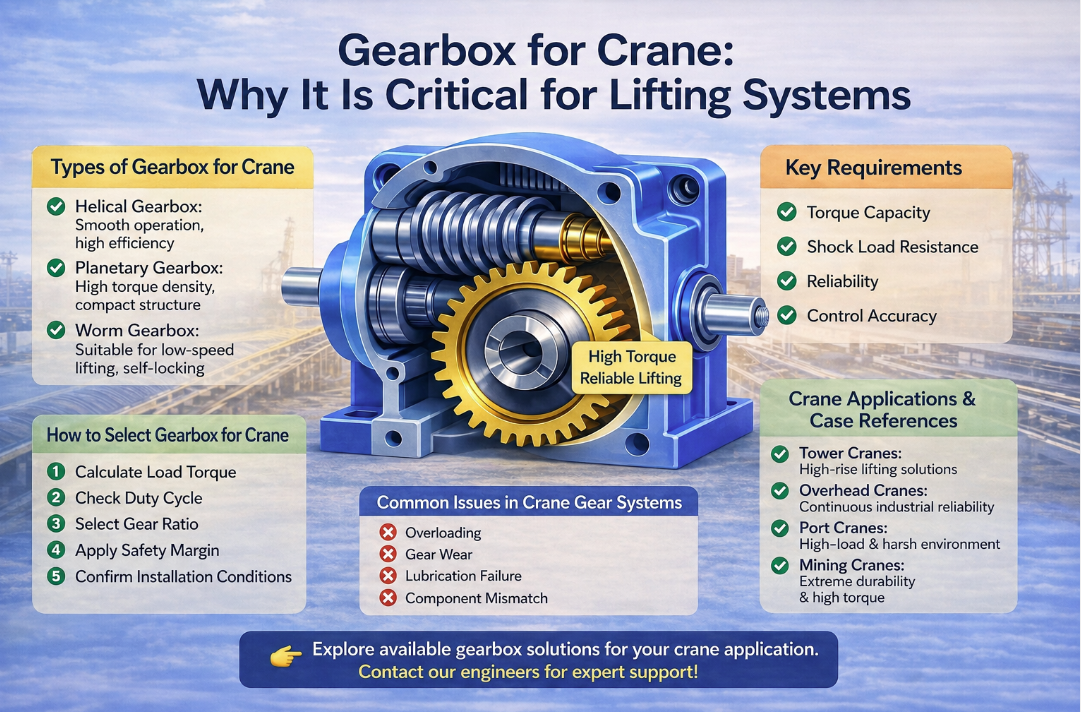
Types of Gearbox for Crane
Different gearbox types are selected depending on load capacity and working environment.
Helical Gearbox for Crane
Helical gear systems are widely used for smooth lifting operations and continuous working conditions. They provide high efficiency and stable transmission performance.
Planetary Gearbox for Crane
Planetary gear systems are commonly used in heavy-duty lifting equipment due to their compact structure and high torque density.
Worm Gearbox for Crane
Worm gear systems are suitable for small cranes and low-speed lifting applications where simple structure and self-locking characteristics are required.
Key Requirements for Crane Gear Systems
Selecting a gearbox requires understanding core lifting design principles from .
Torque Capacity
The gearbox must generate sufficient torque to handle rated lifting loads safely.
Shock Load Resistance
Frequent start-stop operations create impact loads that the system must absorb.
Reliability
Stable long-term operation is essential in industrial environments.
Control Accuracy
Precise motion control improves lifting safety and positioning accuracy.
How to Select Gearbox for Crane
Step 1: Calculate Load Torque
Use proper to determine the required output torque.
Step 2: Check Duty Cycle
Evaluate working frequency, load variation, and operation time.
Step 3: Select Gear Ratio
Match output speed with lifting speed requirements.
Step 4: Apply Safety Margin
Add sufficient overload margin to ensure safe operation.
Step 5: Confirm Installation Conditions
Ensure mechanical compatibility with crane structure and mounting space.
Common Issues in Crane Gear Systems
Typical problems include:
- Overloading
- Gear wear
- Lubrication failure
- Component mismatch
These issues are often caused by incorrect selection or insufficient maintenance practices.
Crane Applications & Case References
For real-world applications and engineering reference cases, see .
- Tower cranes: require stable high-rise lifting performance
- Overhead cranes: require continuous industrial reliability
- Port cranes: operate in high-load and harsh environments
- Mining cranes: demand extreme durability and torque capacity
Conclusion
Selecting the right gearbox for crane significantly improves safety, efficiency, and equipment lifespan. Proper design matching based on load conditions and duty cycle ensures long-term reliable lifting performance.
Explore available to find suitable engineering solutions for your application.