What Is a Gearbox?
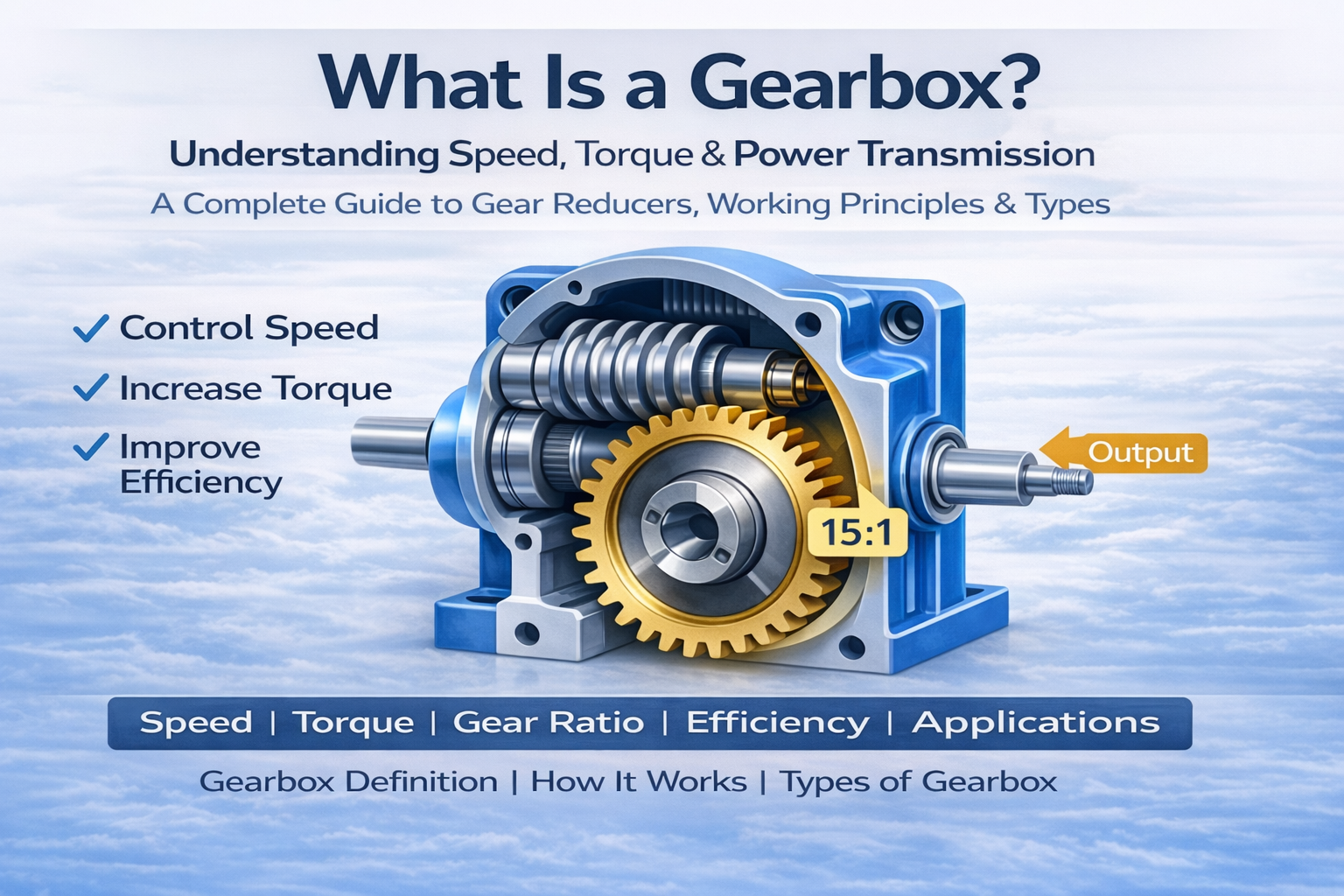
What is a gearbox? A gearbox is a mechanical device used to transmit power and adjust the speed and torque between a motor and a machine. It plays a critical role in ensuring machines operate efficiently under different working conditions.
Industrial machines rely heavily on <a href=”https://motorreducers.com/products/”>gear reducers</a> to adjust speed and torque. Gearboxes are also fundamental components in <a href=”https://en.wikipedia.org/wiki/Gearbox” target=”_blank”>mechanical engineering</a>.
In simple terms, a gearbox helps convert:
- High speed → Low speed
- Low torque → High torque
The main purpose of a gearbox is to ensure machinery operates efficiently under required conditions
How Does a Gearbox Work?
To better understand what is a gearbox, it is important to know how it works.
A gearbox consists of multiple gears that interact with each other. When the input shaft rotates:
- Motion is transferred between gears
- Speed is reduced or increased
- Torque is adjusted
The relationship between speed and torque is defined by the <a href=”https://motorreducers.com/gear-reduction-ratio-formula-calculation-guide/”>gear reduction ratio</a>.
Key principle:
- Higher gear ratio → Lower speed, higher torque
- Lower gear ratio → Higher speed, lower torque
Gearbox Definition and Basics
A gearbox, also known as a gear reducer, is a system of gears arranged to modify energy output. Understanding gearbox definition helps users select the right system for industrial needs.
Gear reducer basics include:
- Power transmission
- Speed control
- Torque conversion
These functions are essential in modern machinery.
Main Components of a Gearbox
A typical gearbox includes:
- Gears – transmit motion
- Shafts – support rotation
- Bearings – reduce friction
- Housing – protects internal parts
- Lubrication system – ensures smooth operation
Each component contributes to durability and efficiency.
Types of Gearbox
There are several types of gearbox used in industrial environments.
Helical Gearbox
- High efficiency
- Smooth and quiet
- Used in conveyors and heavy machinery
Worm Gearbox
- High reduction ratio
- Self-locking capability
- Compact structure
Worm gearboxes are widely used in applications requiring high reduction ratios and self-locking features. Learn more about <a href=”https://motorreducers.com/worm-gearbox
Planetary Gearbox
- High torque density
- Compact design
- High precision
Used in robotics and automation systems.
Why Gearboxes Are Important
Gearboxes are essential because most motors operate at speeds that are not suitable for direct use.
Gear reducers help:
- Match motor speed to machine requirements
- Increase torque
- Improve efficiency
- Protect equipment
- Extend lifespan
Industrial Gearbox Applications
Gearboxes are widely used across industries such as:
- Conveyor systems
- Mining equipment
- Packaging machines
- Wind turbines
- Robotics
- Construction machinery
Different <a href=”https://motorreducers.com/industrial-gearbox-applications/”>industrial gearbox applications</a> require different gearbox types and configurations.
Gearboxes also play a key role in <a href=”https://www.siemens.com/” target=”_bla nk”>industrial automation systems</a> worldwide.
Conclusion
Understanding what is a gearbox is essential for anyone working with machinery or industrial systems. Gearboxes play a critical role in power transmission by controlling speed and torque.
From simple machines to advanced automation systems, gear reducers improve performance, efficiency, and reliability.