What Is Gearbox Sizing?
Gearbox sizing is a critical process used to select the right gearbox based on torque, speed, load, and operating conditions. Gearbox sizing ensures that equipment can run efficiently and reliably without failure.
In industrial applications, proper gearbox sizing helps avoid overheating, excessive wear, and unexpected downtime. Incorrect gearbox sizing may lead to serious mechanical problems and increased maintenance costs.
Why Gearbox Sizing Is Important
Accurate gearbox sizing provides several key benefits:
- Prevents equipment overload
- Improves transmission efficiency
- Extends gearbox lifespan
- Reduces maintenance costs
For industries such as manufacturing, logistics, and automation, gearbox sizing directly impacts productivity and system stability.
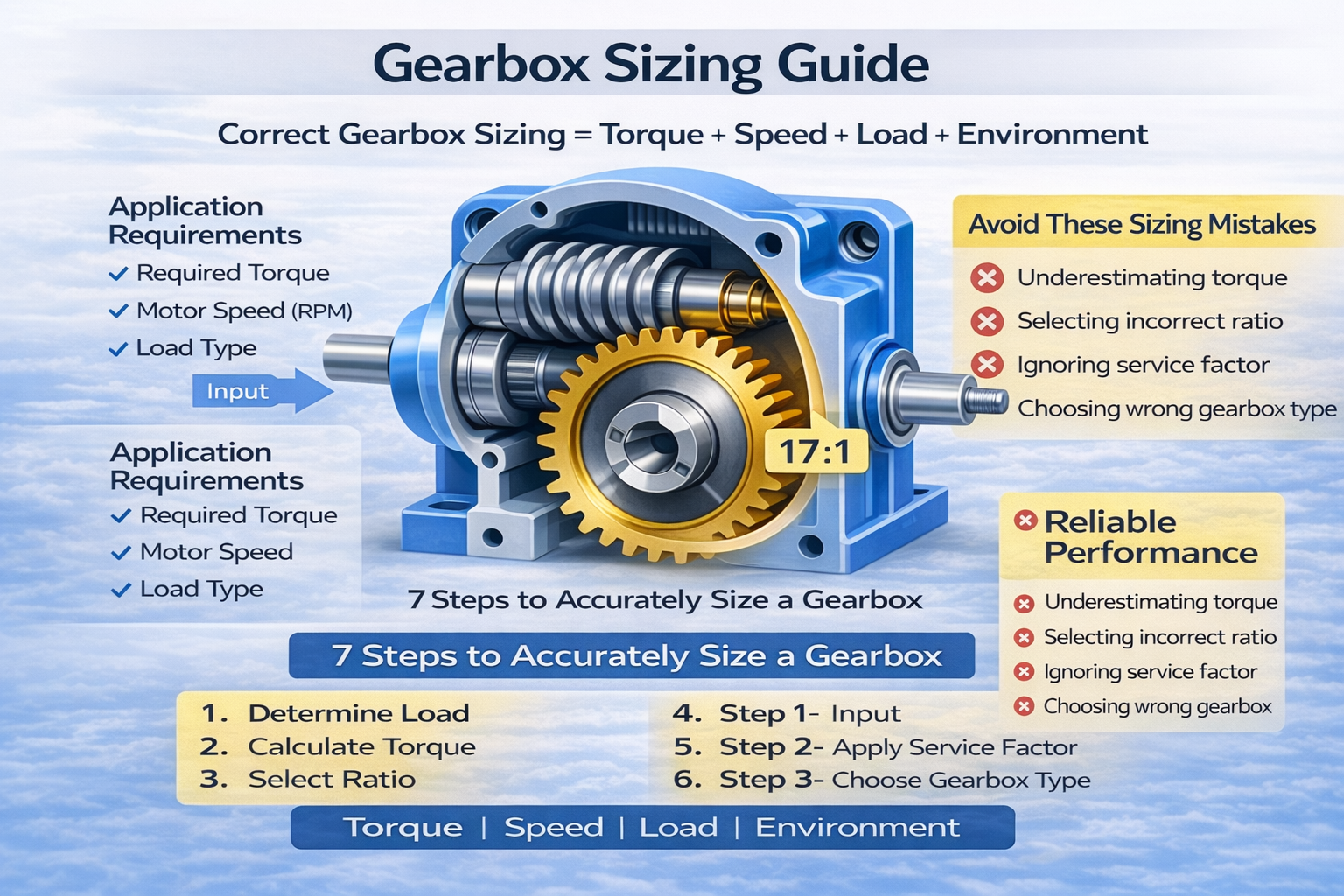
Key Parameters for Gearbox Sizing
1. Torque Requirement
The gearbox must deliver enough torque for the application.
Accurate <a href=”https://motorreducers.com/gearbox-torque-calculation/” title=”Gearbox Torque Calculation”>torque calculation</a> is essential for proper gearbox sizing.
2. Speed (RPM)
Speed defines how fast the motor rotates compared to the output shaft. Proper gearbox sizing depends on matching input and output speed.
3. Gear Reduction Ratio
Gear reduction ratio determines how speed is reduced and torque is increased.
Understanding <a href=”https://motorreducers.com/gear-reduction-ratio-formula-calculation-guide/” title=”Gear Reduction Ratio”>gear reduction ratio</a> is crucial for gearbox sizing.
4. Service Factor
Service factor reflects real working conditions such as shock loads and operating time.
Applying the correct <a href=”https://motorreducers.com/gearbox-service-factor-calculation/” title=”Gearbox Service Factor”>gearbox service factor</a> ensures safe gearbox sizing.
5. Efficiency
Efficiency affects energy loss and overall system performance.
Mechanical calculations are essential for proper sizing. Learn more from
<a href=”https://www.engineeringtoolbox.com/” target=”_blank” rel=”nofollow”>mechanical calculations</a>.
Gearbox Sizing Formula
The core gearbox sizing formula is:
Output Torque = Motor Torque × Gear Ratio × Efficiency
Gearbox sizing is based on industry standards such as
<a href=”https://www.agma.org/” target=”_blank”>gear design standards</a>.
To ensure safety:
Required Torque ≤ Rated Torque × Service Factor
Step-by-Step Gearbox Sizing Guide
Step 1: Determine Load
Identify load type and required torque.
Step 2: Calculate Torque
Use motor data for gearbox sizing calculation.
Step 3: Select Ratio
Choose the correct ratio for speed and torque.
Step 4: Apply Service Factor
Adjust gearbox sizing based on real conditions.
Step 5: Choose Gearbox Type
- Helical gearbox – high efficiency
- Worm gearbox – compact and high ratio
- Planetary gearbox – high precision
Step 6: Check Environment
Ensure proper installation conditions.
Step 7: Verify Gearbox Sizing
Double-check all parameters to confirm correct gearbox sizing.
Common Gearbox Sizing Mistakes
Avoid these common gearbox sizing errors:
- Underestimating torque
- Ignoring service factor
- Wrong gear ratio selection
- Ignoring environment
- Choosing incorrect gearbox type
These mistakes can lead to failure and high costs.
Gearbox Sizing Applications
Conveyor Systems
Require stable torque and continuous operation.
Heavy Machinery
Require high torque and durability.
Automation Systems
Require precision and compact gearbox sizing.
Conclusion
Gearbox sizing is essential for selecting the right gearbox. Proper gearbox sizing ensures reliable performance, longer service life, and improved efficiency.
Proper <a href=”https://motorreducers.com/gearbox-selection-guide/” title=”Gearbox Selection”>gearbox selection</a> depends on accurate gearbox sizing.
Explore high-quality <a href=”https://motorreducers.com/products/” title=”Industrial Gearboxes”>industrial gearboxes</a> for your application needs.