Worm Gearbox vs Helical Gearbox
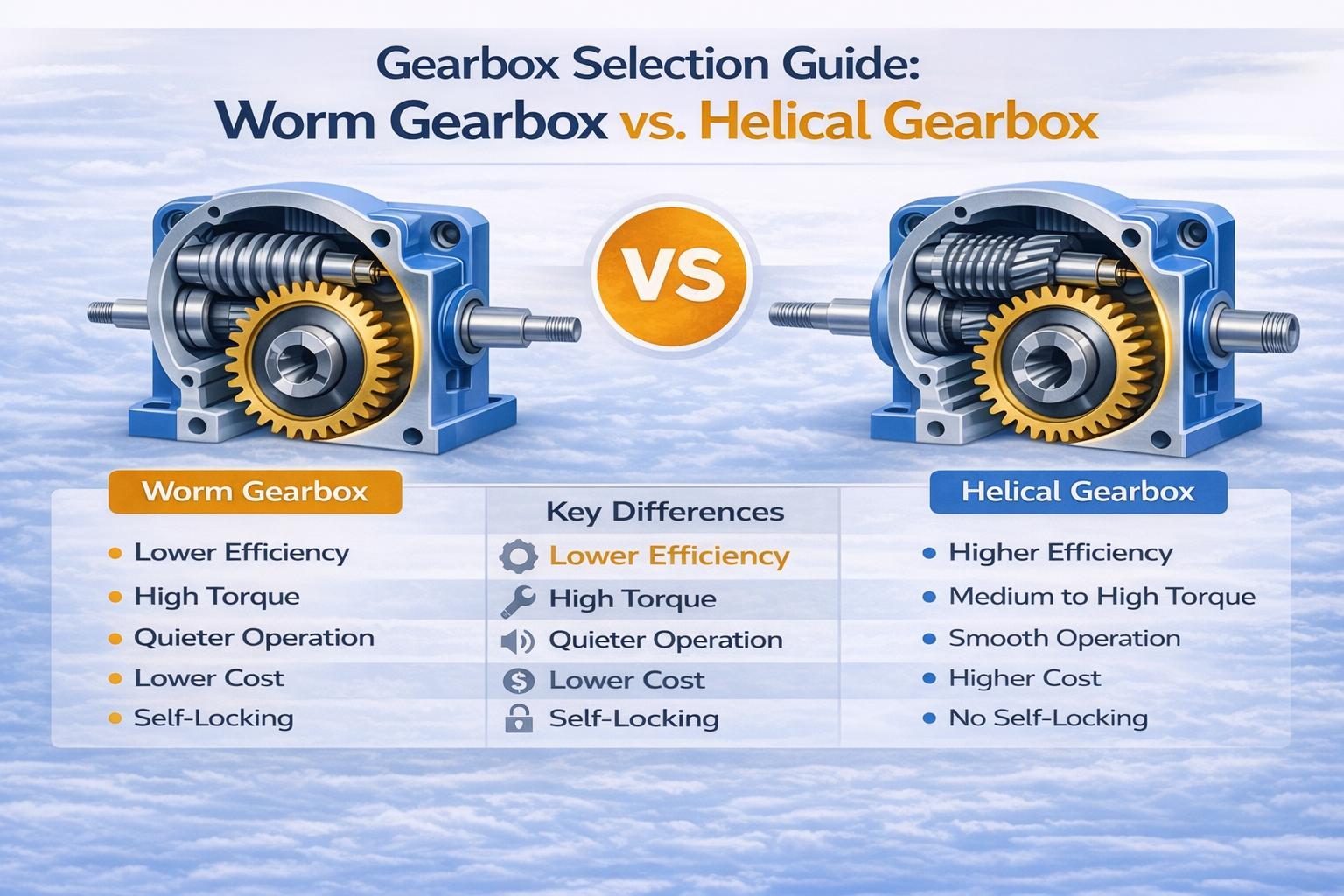
What’s the Difference?
When selecting a gearbox, many engineers compare worm gearbox vs helical gearbox to determine which solution best fits their application.
Both gearbox types are widely used in industrial systems, but they differ significantly in efficiency, torque transmission, cost, and applications.
Understanding these differences is essential for making the right decision.
Gear transmission principles are widely studied in mechanical engineering research.
What Is a Worm Gearbox?
A worm gearbox uses a worm screw and worm wheel to transmit motion between non-parallel shafts.
Key features:
High reduction ratio
Self-locking capability
Smooth and quiet operation
However, worm gearboxes typically have lower efficiency due to sliding contact.
A detailed worm gearbox guide can help you better understand its working principle and advantages.
What Is a Helical Gearbox?
A helical gearbox uses angled teeth to transmit power between parallel shafts.
Key features:
High efficiency
Smooth power transmission
High load capacity
Helical gearboxes are widely used in conveyors, crushers, and industrial machinery.
Helical gearboxes are widely used due to their high efficiency and smooth operation.
Worm Gearbox vs Helical Gearbox: Key Differences
Feature Worm Gearbox Helical Gearbox
Efficiency Medium (50–90%) High (90–98%)
Torque High Medium to High
Noise Very low Low
Cost Lower Higher
Maintenance Low Medium
Self-locking Yes No
Efficiency Comparison
One of thebiggest differences in worm gearbox vs helical gearbox is efficiency.
Worm gearbox → more friction → lower efficiency
Helical gearbox → rolling contact → higher efficiency
For energy-saving applications, helical gearboxes are often preferred.
Gear efficiency varies depending on design and lubrication conditions.
Torque and Load Capacity
Worm gearboxes can provide high torque at low speed, making them suitable for lifting and positioning systems.
Helical gearboxes, on the other hand, are better suited for continuous heavy-duty operation.
Cost Comparison
Worm gearboxes are generally:
More affordable
Easier to install
Helical gearboxes:
Higher initial cost
Better long-term efficiency
Applications Comparison
Worm Gearbox Applications
Lifts and hoists
Conveyors
Gate systems
Packaging machines
Helical Gearbox Applications
Mining equipment
Cement plants
Industrial conveyors
Automation systems
How to Choose Between Worm and Helical Gearbox
Choosing between worm gearbox vs helical gearbox depends on:
Efficiency requirements
Budget
Torque needs
Operating conditions
Choose worm gearbox when:
You need self-locking
Low cost is important
Choose helical gearbox when:
High efficiency is required
Continuous operation is needed
Understanding gearbox selection principles is essential when comparing different gearbox types.
Explore different industrial gearbox solutions to find the best option for your application.
Conclusion
The comparison of worm gearbox vs helical gearbox shows that each has its own advantages. Worm gearboxes are ideal for compact and cost-sensitive applications, while helical gearboxes are better for high-efficiency and heavy-duty systems.
Selecting the right gearbox depends on your specific industrial requirements.