What Is Gearbox Selection?
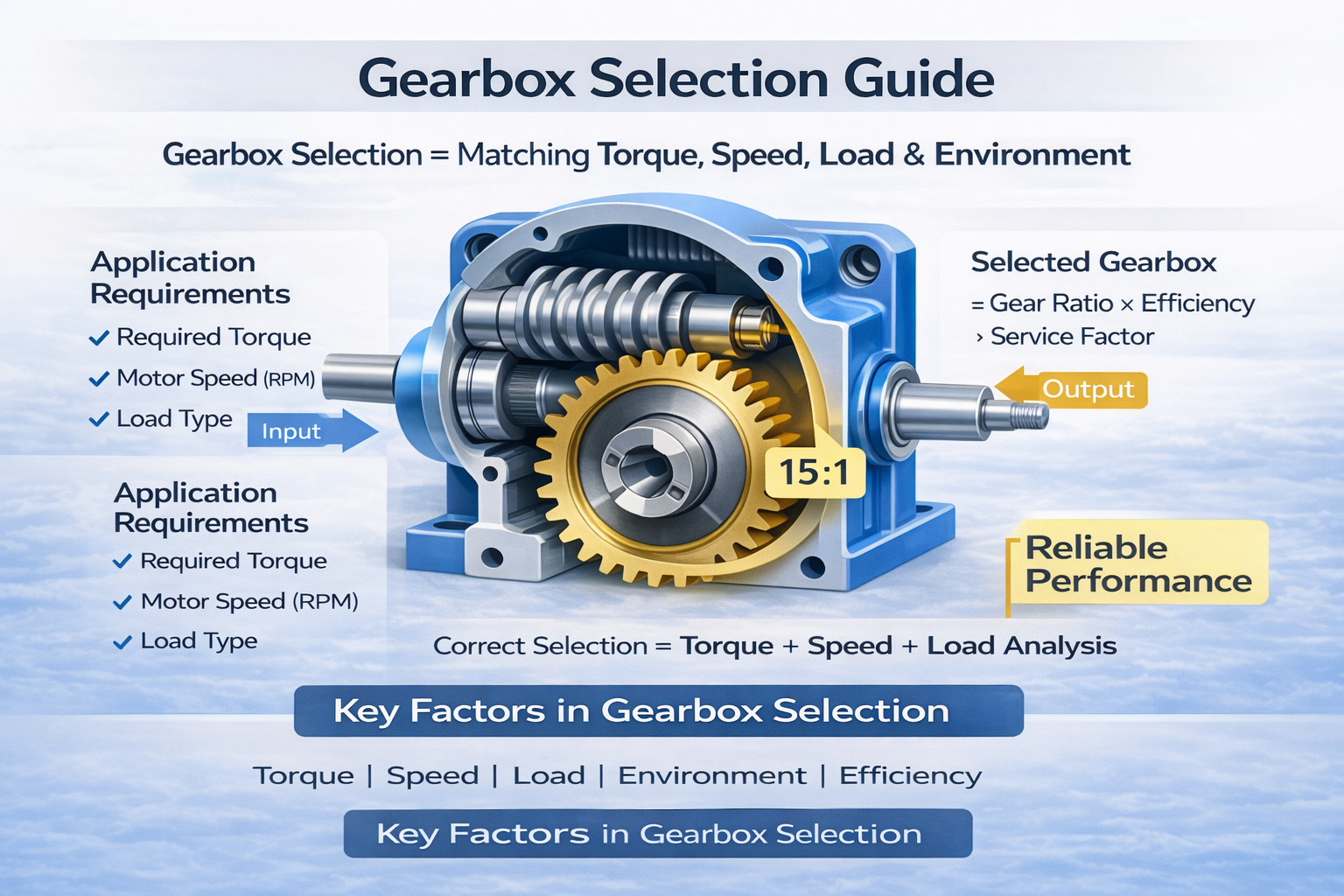
Gearbox selection is the process of choosing the most suitable gearbox based on application requirements such as torque, speed, load conditions, and operating environment.
In industrial systems, selecting the wrong gearbox can lead to:
Equipment failure
Reduced efficiency
Increased maintenance costs
That is why proper gearbox selection is critical for long-term performance and reliability.
Why Gearbox Selection Matters
Choosing the correct gearbox ensures:
Optimal torque transmission
Efficient speed reduction
Longer service life
Lower operating costs
In many industries, engineers carefully analyze working conditions before making a gearbox selection decision.
Gearbox selection is often guided by international mechanical standards such as ISO for power transmission systems.
7 Key Factors for Gearbox Selection
1 Torque Requirement
Torque is the most important factor in gearbox selection.
You must calculate the required output torque based on load conditions.
Accurate torque calculation is essential before selecting a gearbox to ensure reliable performance.
2 Speed (RPM)
Determine:
Input speed (motor speed)
Required output speed
This helps define the gear reduction ratio.
3 Gear Reduction Ratio
The gear ratio determines how speed is reduced and torque is increased.
A correct ratio ensures stable machine operation.
Understanding gear reduction ratio is critical when matching motor speed to application requirements.
4 Load Type
Different loads affect gearbox selection:
Constant load
Shock load
Variable load
Heavy shock loads require stronger gearbox designs.
5 Efficiency Requirements
High-efficiency gearboxes reduce energy consumption.
For example:
Helical gearbox → high efficiency
Worm gearbox → lower efficiency
Many industrial automation systems rely on efficient gearboxes to improve overall system performance.
6 Installation Space
Some applications require compact designs.
Planetary gearboxes are ideal for:
Limited space
High torque density
7 Working Environment
Consider:
Temperature
Dust
Humidity
Corrosion
Harsh environments require special gearbox protection.
Types of Gearboxes for Different Applications
Different applications require different gearbox types.
Helical Gearbox
High efficiency
Smooth operation
Suitable for conveyors
Planetary Gearbox
High torque density
Compact size
Used in robotics and automation
Worm Gearbox
High reduction ratio
Quiet operation
Suitable for lifting equipment
You can explore different industrial gearbox solutions to find the right type for your application.
Common Gearbox Selection Mistakes
Avoid these common errors:
Undersized torque selection
Ignoring service factor
Wrong gear ratio
Not considering environment
These mistakes can lead to premature gearbox failure.
Reviewing real industrial gearbox applications can help you better understand selection principles.
Conclusion
Gearbox selection is a critical step in industrial system design. By understanding torque, speed, gear ratio, and application requirements, engineers can choose the right gearbox for optimal performance and durability.