Gearbox Torque Calculation: The Essential Guide for Engineers
What Is Gearbox Torque?
Gearbox torque refers to the rotational force transmitted through a gearbox. In industrial machines, torque determines whether a gearbox can drive loads such as conveyors, crushers, mixers, or lifting equipment. Industrial machines rely on gear reducers to increase torque while reducing speed.
Understanding gearbox torque calculation is essential for selecting the correct gearbox and ensuring reliable mechanical performance. When a gearbox reduces speed, it increases torque. This is why gear reducers are widely used in heavy-duty industrial applications.
Gearbox Torque Calculation Formula
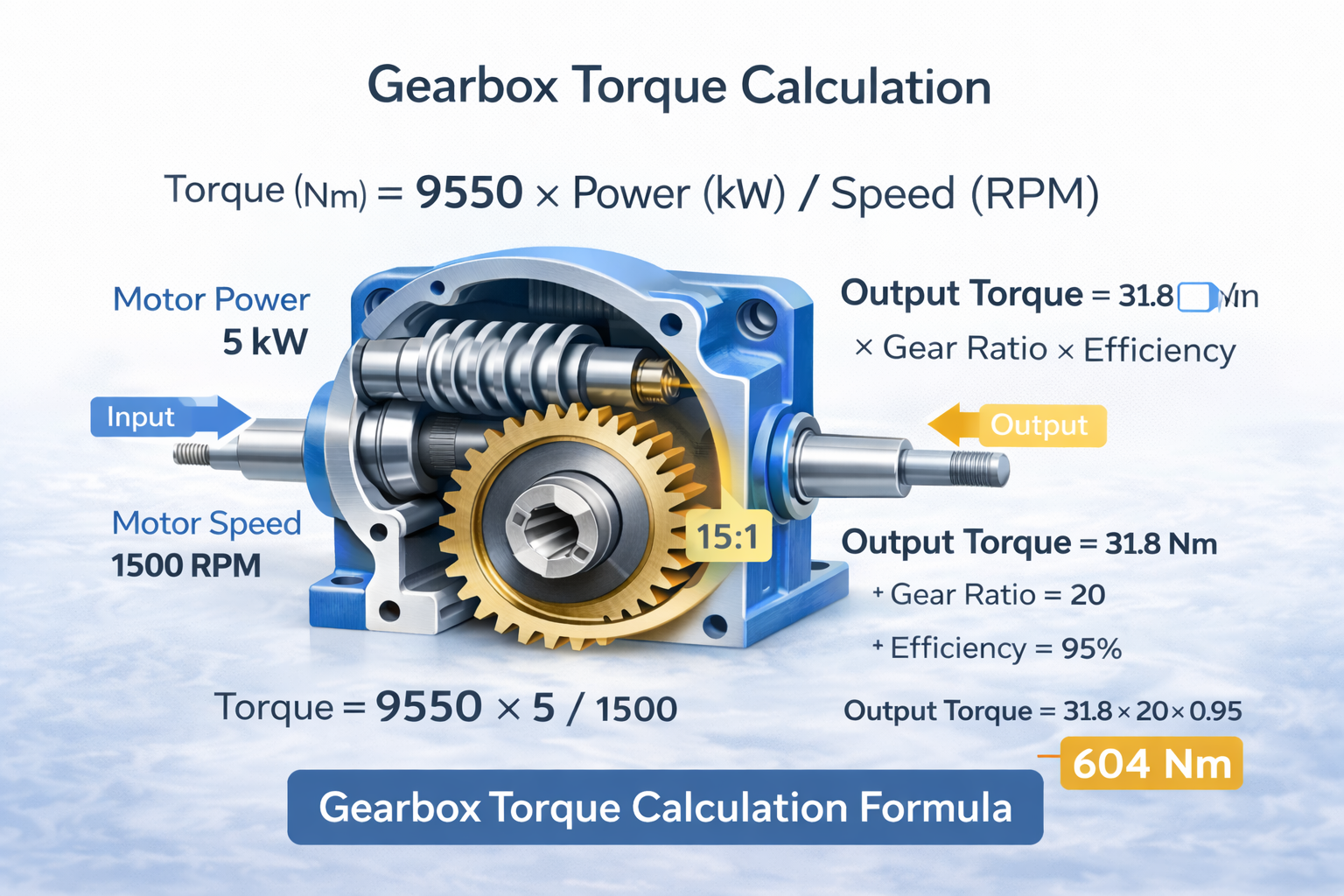
The basic gearbox torque calculation formula is:
Torque calculation formulas are widely used in mechanical engineering torque calculation and power transmission systems.
Example:
-
Motor Power = 5 kW
-
Motor Speed = 1500 RPM
-
Torque = $9550 \times 5 / 1500 = 31.8\ Nm$
This is the motor torque before reduction.
Output Torque After Gear Reduction
After passing through a gearbox, torque increases according to the gear ratio.
Output Torque = Motor Torque × Gear Ratio × Efficiency
Example:
-
Motor Torque = 31.8 Nm
-
Gear Ratio = 20
-
Efficiency = 95%
-
Output Torque = $31.8 \times 20 \times 0.95 = 604\ Nm$
This shows how gear reducers significantly increase torque while reducing speed.
Why Gearbox Torque Calculation Is Important
Proper gearbox torque calculation helps engineers:
-
Select the correct gearbox size
-
Prevent gearbox overload
-
Improve equipment reliability
-
Increase mechanical efficiency
Without accurate torque calculation, a gearbox may fail prematurely or operate inefficiently.
Typical Industrial Applications
Torque calculations are fundamental in industrial power transmission systems. Gearbox torque calculations are commonly used in:
-
Conveyor systems
-
Mining equipment
-
Cement plants
-
Packaging machinery
-
Industrial mixers
-
Wind turbine drive systems
These applications require precise torque control to ensure stable operation.
Choosing the Right Gearbox for Torque Requirements
Different gearbox types provide different torque capabilities.
| Gearbox Type | Torque Capacity |
| Helical Gearbox | High efficiency and medium torque |
| Planetary Gearbox | Very high torque density |
| Worm Gearbox | Smooth transmission but lower efficiency |
Planetary gearboxes are widely used when high torque density is required in industrial systems. Planetary gearboxes are often used when very high torque output is required in compact equipment.
Conclusion
Understanding gearbox torque calculation is essential for selecting the correct gearbox and ensuring reliable machine performance. By using simple torque formulas and considering gear ratio and efficiency, engineers can determine the required output torque for any industrial application. Proper maintenance and lubrication can also help maintain gearbox maintenance tips and torque performance.